

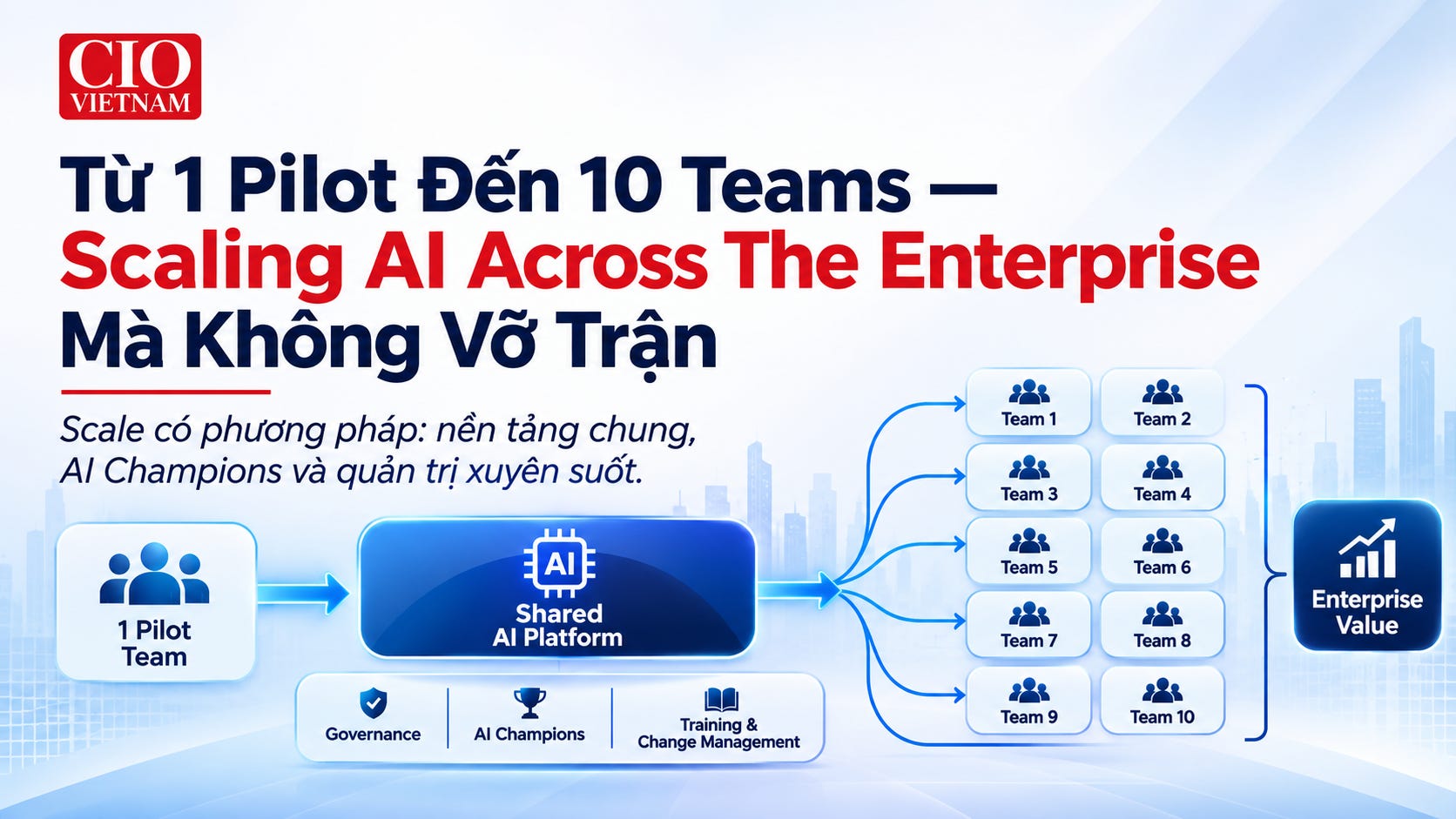
Pilot thành công xong… rồi sao?
Đây là kịch bản quen thuộc: Bạn chọn 1 team thử nghiệm AI. Kết quả tuyệt vời — productivity tăng 30%, team hào hứng, stakeholders impressed. CEO nói: “Tuyệt, roll out cho toàn bộ công ty đi.”
Và đây là lúc mọi thứ bắt đầu vỡ.
Team thứ 2 dùng AI khác team đầu. Team thứ 3 không có champion nên adopt chậm. IT không kịp provision licenses. Security lo ngại data leak. Finance hỏi budget từ đâu. HR nói cần policy trước. Legal nói cần review compliance.
Pilot thành công ≠ Scale thành công. Đây là hai bài toán hoàn toàn khác nhau. Pilot là sprint — scale là marathon.
Bài này tôi chia sẻ playbook để đi từ 1 team pilot đến AI adoption toàn doanh nghiệp mà không để mọi thứ rối tung.
AI Maturity Model: Bạn đang ở đâu?
Trước khi scale, cần biết mình đang ở giai đoạn nào. Đây là maturity model 4 giai đoạn mà tôi dùng:
Stage 1: EXPERIMENT (Tháng 1-3)
Đặc điểm: - Một vài cá nhân dùng AI tools tự phát (ChatGPT, Copilot) - Không có policy, không có budget chính thức - Use cases: ad-hoc, chủ yếu personal productivity - Leadership biết nhưng chưa chú ý nhiều
Signals bạn đang ở đây: - Nhân viên dùng ChatGPT bằng tài khoản cá nhân - Không ai biết doanh nghiệp đang “dùng AI” ở đâu - Không có ngân sách riêng cho AI
Để chuyển sang Stage 2: Chọn 1 use case cụ thể, assign owner, allocate pilot budget.
Stage 2: PILOT (Tháng 3-6)
Đặc điểm: - 1-2 teams thử nghiệm AI có structured approach - Có budget pilot (~$10K-$50K) - Đo lường kết quả cụ thể - IT bắt đầu evaluate tools và security
Signals bạn đang ở đây: - Có 1 team dùng AI tools được IT approved - Đang collect metrics (velocity, quality, satisfaction) - Một vài success stories nhưng chưa consistent
Để chuyển sang Stage 3: Document playbook từ pilot, build business case với ROI data, get leadership commitment.
Stage 3: SCALE (Tháng 6-18)
Đặc điểm: - 5-10 teams đang adopt AI - AI budget chính thức trong annual planning - AI Governance framework deployed - Dedicated resource (AI Lead hoặc small platform team) - Cross-team learning mechanisms
Signals bạn đang ở đây: - Có AI usage policy company-wide - Multiple teams dùng AI nhưng ở mức maturity khác nhau - Bắt đầu thấy organizational-level impact (not just team-level)
Để chuyển sang Stage 4: Standardize platform, measure organization-wide ROI, embed AI into core processes.
Stage 4: OPTIMIZE (Tháng 18+)
Đặc điểm: - AI embedded vào core business processes - Continuous optimization dựa trên data - AI Center of Excellence driving innovation - Organization culture đã shift — AI là default, not exception - Measuring second-order effects (market position, talent attraction)
Signals bạn đang ở đây: - Mọi team đều dùng AI ở mức nào đó - AI metrics là part of business KPIs - Team tự identify AI use cases (bottom-up innovation) - Bạn đang compete dựa trên AI capabilities
Thực tế VN hiện tại: Đa số doanh nghiệp ở Stage 1-2. Một số fintech, e-commerce lớn ở Stage 3. Chưa có nhiều ở Stage 4. Đây là cơ hội — early movers sẽ có lợi thế lớn.
Organizational Change Management: Phần khó nhất
Technology không phải bottleneck khi scale AI. Con người mới là bottleneck.
3 nhóm người bạn sẽ gặp
Enthusiasts (15-20%): Đã dùng AI tự phát, hào hứng, muốn dùng nhiều hơn. - Cách leverage: Biến họ thành AI Champions, để họ train và inspire người khác.
Wait-and-see (60-70%): Biết AI tồn tại, chưa thử nghiêm túc, chờ xem đồng nghiệp dùng thế nào. - Cách activate: Show them peer results (không phải vendor demo), hands-on workshop, pair họ với Enthusiasts.
Resistors (10-20%): Lo AI thay thế mình, không tin AI quality, hoặc đơn giản là ngại thay đổi. - Cách handle: Listen first — nhiều concerns là hợp lệ. Address cụ thể: “AI không thay bạn, AI giúp bạn làm tốt hơn phần bạn giỏi.” Đừng force — cho thời gian, nhưng set expectation rõ.
AI Champions Program
Đây là mechanism hiệu quả nhất tôi thấy cho AI scaling:
Cấu trúc: - Chọn 1-2 AI Champions per team (từ nhóm Enthusiasts) - Champions dành 10-20% thời gian cho AI adoption activities - Monthly champion meetup — share learnings, challenges, best practices - Champions báo cáo cho AI Lead/CIO
Trách nhiệm Champion: 1. Identify AI use cases trong team mình 2. Pilot và document kết quả 3. Train team members (peer learning) 4. Collect feedback và escalate issues 5. Share success stories cross-team
Tại sao hiệu quả: Mọi người trust đồng nghiệp hơn trust management mandate. Khi developer A thấy developer B (cùng team, cùng level) dùng AI hiệu quả — impact mạnh hơn 100 lần so với CTO gửi email “hãy dùng AI.”
Training Roadmap
Không phải ai cũng cần học như nhau. Chia thành 3 levels:
Level 1: AI Awareness (Tất cả nhân viên, 2 giờ) - AI là gì, AI làm gì tốt, AI làm gì chưa tốt - Company AI Policy — điều gì được phép, điều gì không - Hands-on: Thử dùng 1 AI tool cho 1 task cụ thể - Format: Online + self-paced
Level 2: AI Practitioner (Team members dùng AI daily, 8 giờ) - Prompt engineering cho role-specific tasks - AI tools deep dive (tool phù hợp với role) - Best practices: review AI output, quality control - Hands-on workshop: Xử lý 5 real tasks với AI - Format: In-person workshop, nhóm 10-15 người
Level 3: AI Builder (Champions + Technical leads, 16 giờ) - AI architecture basics (API, RAG, fine-tuning concepts) - Evaluate và select AI tools cho team - Build simple AI workflows (no-code/low-code) - Measure và optimize AI impact - Format: 2-day intensive workshop
Handling Resistance — Scripts thực tế
“AI sẽ thay thế công việc của tôi” > “Tôi hiểu concern này. Thực tế là AI thay đổi công việc, không thay thế người. Trong 12 tháng qua, chúng ta chưa giảm headcount vì AI. Nhưng người biết dùng AI đang deliver nhiều hơn. Tôi muốn bạn ở phía đó.”
“AI output không đáng tin” > “Đúng — AI có thể sai. Vì vậy chúng ta không để AI quyết định alone. AI draft, người review. Giống như junior developer viết code vẫn cần code review — AI output cần human review.”
“Tôi không có thời gian học thêm” > “Ban đầu tốn thời gian thật. Nhưng data cho thấy sau 2-3 tuần, mọi người tiết kiệm 5-8 giờ/tuần. Đó là khoản đầu tư 10 giờ học để tiết kiệm 300+ giờ/năm.”
“Dùng AI là cheating” > “Dùng Excel thay vì tính tay có phải cheating không? Dùng Google thay vì lên thư viện có phải cheating không? Tools phát triển, cách làm việc phát triển. Giá trị của bạn không nằm ở việc làm mọi thứ manual — mà ở judgment, creativity, và experience.”
Ai Nên Own AI? Mô hình tổ chức
Option 1: IT Department Owns
Ưu điểm: Leverage existing infrastructure, security, governance capabilities. Nhược điểm: IT thường reactive, risk-averse, và xa business context. Phù hợp khi: Company nhỏ, AI là tool hỗ trợ.
Option 2: Data Team Owns
Ưu điểm: Có ML expertise, hiểu data landscape. Nhược điểm: Data team thường focus vào analytics, không phải product/operations. Phù hợp khi: AI use cases chủ yếu là data-driven (analytics, prediction).
Option 3: AI Center of Excellence (CoE) — Recommended cho Scale stage
Cấu trúc:
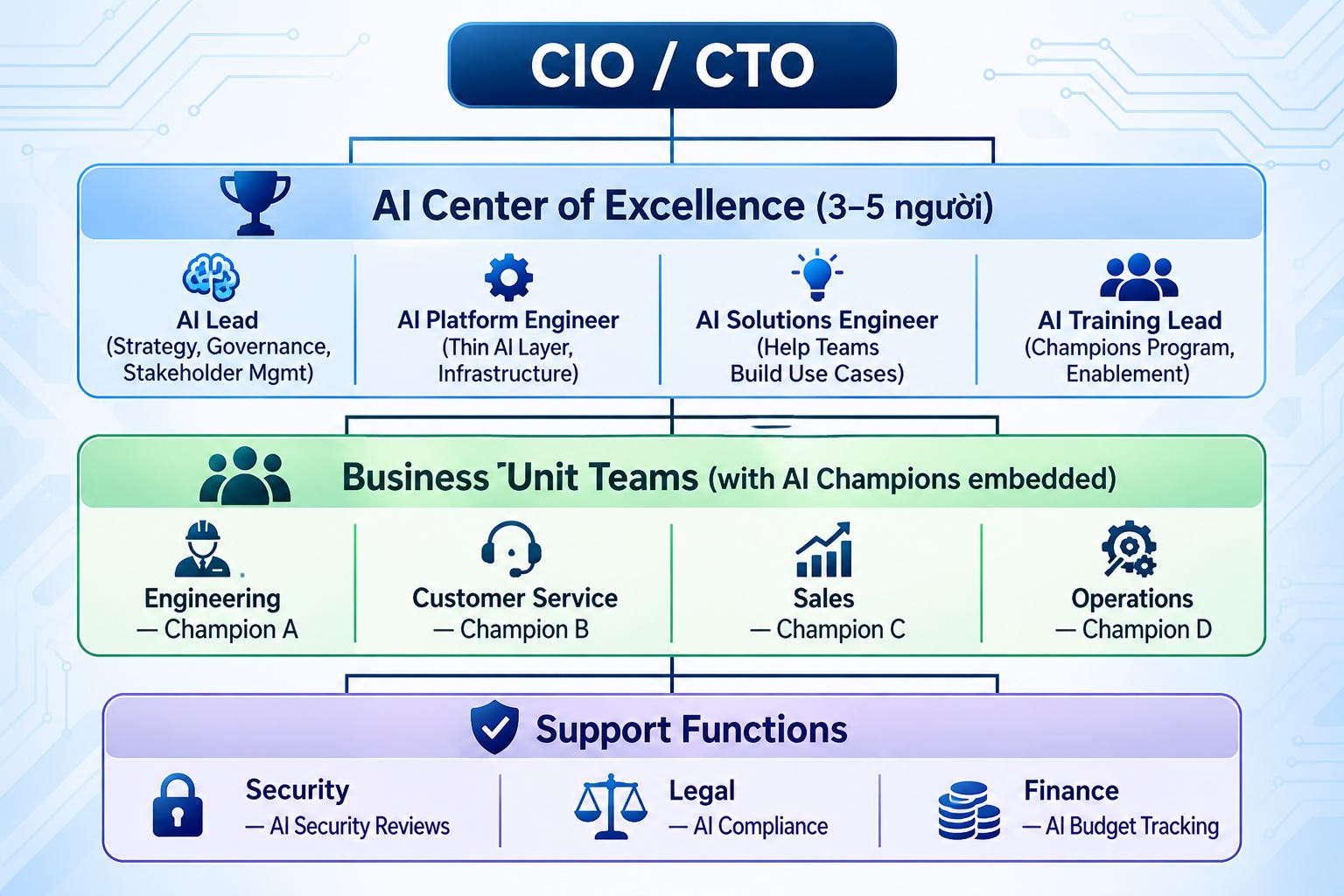
AI CoE làm gì: 1. Evaluate & Approve: Mọi AI tool/vendor mới phải qua CoE review 2. Platform: Build và maintain Thin AI Layer, shared infrastructure 3. Enable: Training, champions program, playbooks 4. Govern: AI policy enforcement, audits, incident response 5. Innovate: Horizon scanning — AI developments nào relevant cho company
AI CoE KHÔNG làm: - Không build AI solutions cho từng team (teams tự build với support) - Không thay thế team-level decision making - Không trở thành bottleneck (approve within 5 business days, max)
Option 4: Federated Model — Cho Stage 4
Khi AI maturity cao, CoE giải tán dần. AI capabilities embedded vào mỗi team. CoE chỉ giữ lại governance và platform functions. Giống như Agile — ban đầu cần Agile coaches, sau đó teams tự chạy.
12-Month Rolling Plan: From Pilot to Scale
Quarter 1: Foundation (Tháng 1-3)
Month 1: - [ ] Complete AI audit (danh sách mọi AI tools đang dùng) - [ ] Appoint AI Lead (có thể part-time, CTO hoặc senior tech lead kiêm nhiệm) - [ ] Select 2 pilot teams (1 tech, 1 non-tech) - [ ] Allocate pilot budget ($20K-$50K)
Month 2: - [ ] Deploy AI tools cho pilot teams - [ ] Draft AI Usage Policy v1.0 - [ ] Identify 4-6 AI Champions (2-3 per pilot team) - [ ] Baseline metrics: velocity, quality, satisfaction cho pilot teams
Month 3: - [ ] Pilot teams: first results review - [ ] Finalize AI Usage Policy, leadership sign-off - [ ] Level 1 training cho all team leads - [ ] Champions: first monthly meetup
Quarter 2: Expand (Tháng 4-6)
Month 4: - [ ] Expand to 4-6 teams based on pilot learnings - [ ] Deploy monitoring cho AI tool usage - [ ] Start building Thin AI Layer (if hybrid approach) - [ ] Champions program: add 4-6 new champions
Month 5: - [ ] Level 2 training cho expanded teams - [ ] First AI governance audit (Tier 3 use cases) - [ ] Vendor assessment cho new AI tools requested by teams - [ ] Collect and publish first success stories (internal)
Month 6: - [ ] Mid-year review: ROI assessment across all pilot teams - [ ] AI CoE proposal (go from informal to formal) - [ ] Budget request for H2 based on data - [ ] External sharing: 1 blog post / conference talk about learnings
Quarter 3: Standardize (Tháng 7-9)
Month 7: - [ ] AI CoE officially established (if approved) - [ ] Thin AI Layer v1.0 in production - [ ] Company-wide AI tool standardization (approved tools list) - [ ] Level 1 training: all employees
Month 8: - [ ] Expand to 8-10 teams - [ ] Self-service AI onboarding (new teams can start without waiting for CoE) - [ ] AI Champions conference (half-day, cross-team sharing) - [ ] Second governance audit
Month 9: - [ ] Company-wide AI usage metrics dashboard - [ ] AI integrated into performance review conversations (not as KPI, but as enablement) - [ ] Partner/vendor review: renegotiate based on usage data - [ ] Q3 ROI report to leadership
Quarter 4: Optimize (Tháng 10-12)
Month 10: - [ ] Advanced use cases: cross-team AI workflows - [ ] AI in customer-facing products (if applicable) - [ ] Cost optimization: caching, routing, model selection - [ ] Level 3 training cho new champions
Month 11: - [ ] Annual AI strategy review preparation - [ ] Third governance audit - [ ] Innovation sprint: teams propose new AI use cases for next year - [ ] Budget planning for Year 2
Month 12: - [ ] Annual AI Impact Report (ROI, adoption, incidents, lessons) - [ ] Year 2 AI strategy and roadmap - [ ] Champions recognition (bonuses, public recognition) - [ ] Retrospective: What worked, what didn’t, what to change
Metrics framework: Đo đúng thứ cần đo
Adoption Metrics (Leading indicators)

Impact Metrics (Lagging indicators)

Health Metrics (Guardrails)

Những sai lầm phổ biến khi scaling — và cách tránh
Sai lầm 1: “Big Bang” rollout
Vấn đề: Deploy AI cho toàn bộ công ty cùng lúc. Overwhelm IT, training thiếu, resistance cao. Cách tránh: Wave-based approach. 2-3 teams per wave, mỗi wave cách nhau 4-6 tuần.
Sai lầm 2: Top-down mandate không có support
Vấn đề: CEO email “mọi người phải dùng AI” nhưng không có training, tools, hoặc time. Cách tránh: Mandate + enablement. Mỗi mandate phải đi kèm: budget, training, tools, dedicated support.
Sai lầm 3: Đo sai metric
Vấn đề: Đo “số lần dùng AI tool” thay vì “impact.” Team dùng AI cho mọi thứ, kể cả khi không cần. Cách tránh: Đo outcome, không đo output. “Feature delivery time giảm 25%” > “10,000 AI queries/month.”
Sai lầm 4: Không invest vào platform
Vấn đề: Mỗi team tự setup AI → 10 teams, 10 cách khác nhau, 10 security gaps. Cách tránh: Thin AI Layer từ sớm. Centralize platform, decentralize use cases.
Sai lầm 5: Quên người không dùng AI
Vấn đề: Focus vào early adopters, bỏ qua 60% “wait-and-see.” Gap widens. Cách tránh: Champions program bridge gap. Regular check-ins với non-adopters. Empathy, không phải pressure.
Kết luận: Scale là game of patience
Pilot thành công trong 8 tuần. Scale thành công cần 12-18 tháng.
Không có shortcut. Không có magic tool. Không có consultant nào có thể thay bạn làm change management.
Nhưng có methodology. Có playbook. Và có community — CIO Vietnam — nơi chúng ta chia sẻ learnings thật, không phải vendor marketing.
AI scaling không phải technology project. Đó là organizational transformation project mà tình cờ dùng technology.
CIO là người duy nhất trong C-suite có đủ technical depth VÀ organizational breadth để lead transformation này. Own it.
Frank Luong, AI Chapter Lead, CIO Vietnam
